
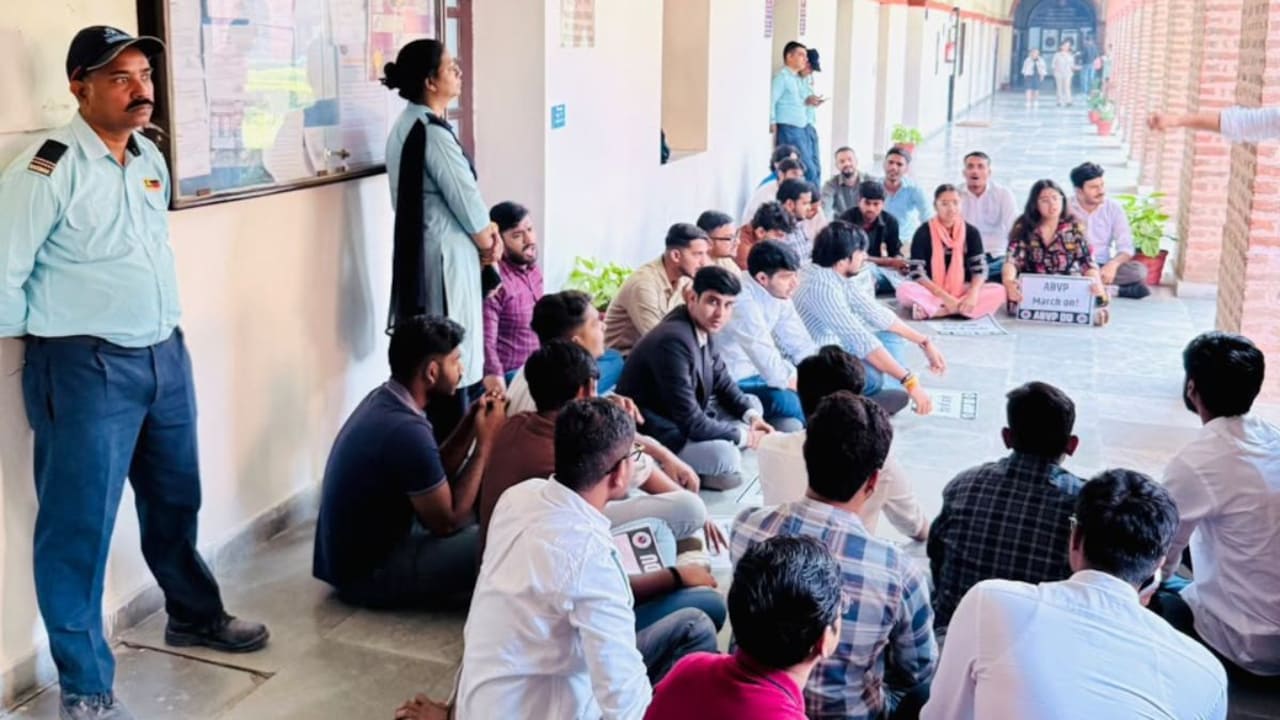
The flashpoint occurred late Sunday evening when the department issued official notifications scheduling critical interviews for the very next morning, October 28. For hundreds of eligible scholars who had cleared rigorous preliminary screening tiers, the overnight turnaround made physical attendance virtually impossible, particularly for outstation candidates residing beyond the national capital region. Protesters forcefully argued that the sudden scheduling directly infringed upon institutional transparency mandates and severely jeopardized the academic futures of meritorious applicants.
The disruption highlights systemic vulnerabilities within central university admission workflows, laying bare the widening trust deficit between student bodies and academic administrators. As slogans echoed across the arts faculty quadrangle, university security and local law enforcement deployed barricades to contain the escalating agitation. The department’s failure to execute the admission cycle on schedule has now triggered broader institutional introspection regarding fairness, accessibility, and operational accountability in premier higher education institutions across India.
📌 Essential Story Takeaways
- Delhi University's Hindi Department suspended scheduled PhD interviews for October 28 following intense student-led protests.
- The Akhil Bharatiya Vidyarthi Parishad (ABVP) and DUSU spearheaded the agitation against an overnight notice period.
- Hundreds of outstation candidates faced severe logistical barriers due to the lack of adequate advance communication.
- University authorities have yet to announce a revised timetable, leaving thousands of doctoral aspirants in bureaucratic limbo.
Historical Background & Contextual Precedents
In recent years, however, the academic calendar across central institutions has experienced severe compression due to post-pandemic rescheduling and revised academic session guidelines issued by the University Grants Commission (UGC). Departments frequently find themselves racing against compressed timelines to finalize admissions before mandated semester deadlines. This systemic pressure has inadvertently fostered a culture of last-minute administrative clearances, where procedural compliance is compromised for the sake of speed.
Furthermore, the integration of centralized entrance portals such as the CUET (Common University Entrance Test) has added layers of bureaucratic complexity. While designed to streamline admissions, the transition has created synchronization bottlenecks between testing agencies and individual department boards. Today’s confrontation surfaced because aspirants, already wearied by delayed examination cycles, perceived the overnight notice not merely as an administrative oversight, but as an intentional disenfranchisement of non-privileged candidates who lack local logistical support systems in New Delhi.
Deep-Dive Investigation & Sectoral Impact
Instead of deferring the interview cycle to the following week to ensure proper compliance with notification norms, departmental authorities opted for an emergency dispatch model. Notifications were uploaded to the university portal and disseminated via departmental WhatsApp groups past 10:00 PM on Sunday. Ground reports from the North Campus indicate that this digital-first, instantaneous communication strategy fundamentally disadvantaged scholars from marginalized socio-economic backgrounds, many of whom lack uninterrupted internet access or reside in peripheral rural districts where physical travel arrangements cannot be mobilized within a twelve-hour window.
Power dynamics within the university further exacerbated the standoff. Student unions, particularly the ABVP, capitalized on the palpable outrage among stranded aspirants, transforming an administrative failure into a high-visibility political confrontation. Interviews with affected scholars underscore a profound sense of institutional alienation. Many reported spending exorbitant sums on tatkal train tickets upon receiving the midnight notification, only to find the faculty gates locked behind protesting crowds the following morning. The episode exposes a widening chasm between insulated academic officialdom and the ground realities faced by contemporary Indian researchers.
Stakeholder Perspectives & Official Statements
DUSU President Ronit Dahiya launched a scathing attack on the university administration, stating, ‘The arbitrary issuance of overnight notices is a direct assault on the democratic fabric of Delhi University. This is not just administrative inefficiency; it is a systemic attempt to shut the doors of higher education to students coming from modest backgrounds who cannot afford emergency travel.’
Echoing similar sentiments, ABVP state secretary Harsh Attri warned of intensified state-wide agitations if accountability is not fixed. ‘We will not allow the academic careers of hundreds of researchers to be toyed with by callous bureaucrats sitting in ivory towers. The department must issue a formal apology and release a transparent, extended calendar immediately,’ Attri declared during the campus rally.
Conversely, senior officials within the Hindi Department, speaking on condition of anonymity, defended the urgency of the schedule, citing intense pressure from the central university administration to conclude doctoral admissions and align with the UGC academic calendar. One senior professor noted, ‘The delay in finalizing the screening panels was beyond our control due to external expert availability constraints. We attempted to expedite the process in good faith to prevent the entire academic session from sliding by another month. While we acknowledge the logistical inconvenience, the protests have disproportionately paralyzed an essential academic milestone.’
Strategic Implications & Future Roadmap
From a policy perspective, this incident is likely to serve as a cautionary tale for other departments across Delhi University that are currently processing doctoral and postgraduate admissions for the 2024-25 academic session. The university administration faces mounting pressure from student bodies and faculty associations alike to establish a standardized, non-negotiable advance notice threshold of at least seven business days for all viva-voce and interview rounds.
Economically and socially, the disruption underscores the hidden costs borne by aspirants from non-metropolitan regions who navigate India’s hyper-competitive higher education landscape. As the university recalibrates its timeline, critical dates to watch include the official notification release, anticipated within the next 48 to 72 hours, and the subsequent rescheduling of interview panels, which will test the administration’s capacity to restore order and rebuild institutional trust.
❓ Key Questions Answered (FAQ)
The crisis was triggered by the Hindi Department's decision to issue an overnight notification on Sunday, October 27, scheduling mandatory PhD interviews for the very next morning, leaving candidates with insufficient time to arrange travel.
Outstation doctoral aspirants, particularly those from socio-economically marginalized backgrounds, bore the brunt of the logistical failure. The immediate consequence was the total suspension of the interview process following violent protests led by ABVP and DUSU.
Key milestones include the official release of the revised interview schedule by Delhi University administration, expected within the week, and subsequent departmental communiqués regarding standardized notification policy reforms.


