
Sunday, October 18, 2026•🌤️Verified Digital Daily
BREAKING
[World & Geopolitics]Strict Time Caps on Firecracker Bursting Imposed by Minister Amid Rising Air Quality Concerns•[World & Geopolitics]BJP Leader’s Singer Wife, A Kabir Bhajan Gone Viral, And The ‘Jantar Mantar’ That Wasn’t•[Business & Economy]Sun Pharma Q2 Results: Profit Falls 36% YoY to Rs 1,989 Crore on Exceptional Charges•[Business & Economy]India made ‘remarkable progress’ in reducing poverty: World Bank•[Science & Technology]AU Small Finance Bank Investigates Potential Leak; Vijay Sales Systems Allegedly Offered for Sale•[Science & Technology]India Orders Sun Pharma to Halt Eye-Care Drug Production at Plant After Quality Lapses•[Sports & Games]Rohit Sharma Explains Why He Never Got To Wear His First Choice Jersey Number•[Sports & Games]ACT: India extends winning run, seals spot in the semifinals as Malaysia advances alongside•[National Affairs]Delhi Air Quality Drops To 78 After Record Rain Brings Winter Chill•[National Affairs]Supreme Court asks Centre to take measures against online misuse of court feeds•[World & Geopolitics]Strict Time Caps on Firecracker Bursting Imposed by Minister Amid Rising Air Quality Concerns•[World & Geopolitics]BJP Leader’s Singer Wife, A Kabir Bhajan Gone Viral, And The ‘Jantar Mantar’ That Wasn’t•[Business & Economy]Sun Pharma Q2 Results: Profit Falls 36% YoY to Rs 1,989 Crore on Exceptional Charges•[Business & Economy]India made ‘remarkable progress’ in reducing poverty: World Bank•[Science & Technology]AU Small Finance Bank Investigates Potential Leak; Vijay Sales Systems Allegedly Offered for Sale•[Science & Technology]India Orders Sun Pharma to Halt Eye-Care Drug Production at Plant After Quality Lapses•[Sports & Games]Rohit Sharma Explains Why He Never Got To Wear His First Choice Jersey Number•[Sports & Games]ACT: India extends winning run, seals spot in the semifinals as Malaysia advances alongside•[National Affairs]Delhi Air Quality Drops To 78 After Record Rain Brings Winter Chill•[National Affairs]Supreme Court asks Centre to take measures against online misuse of court feeds•
WORLD7 min read•✓ Verified Fact-Checked Report

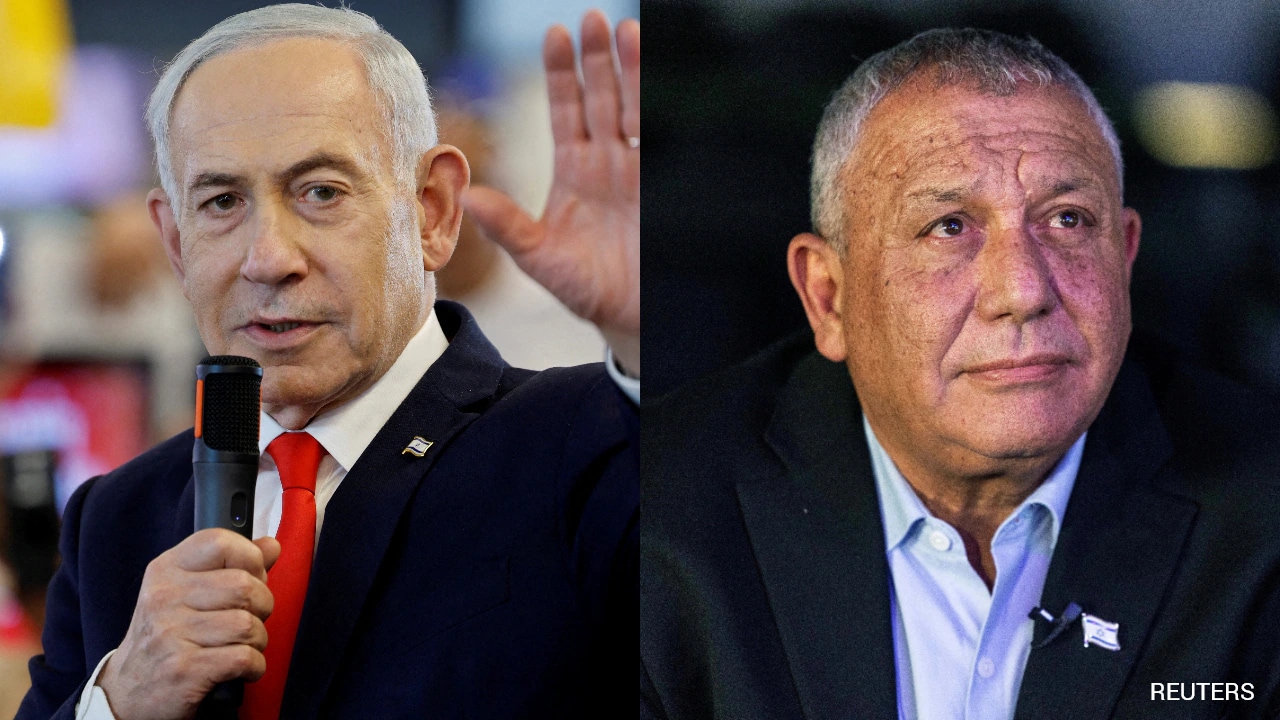
Israel Election Gridlock: Netanyahu and Eisenkot Claim Mandate as Nation Faces Historic Political Showdown

The political landscape of Israel has been thrown into unprecedented turmoil as incumbent Prime Minister Benjamin Netanyahu and his primary centrist challenger, Gadi Eisenkot, both…

A
Abinash
Verified Editorial Staff
Published: Wed, Oct 28, 2026
New Delhi Bureau • Movement News Digital
Share This Story
Israel Election Gridlock: Netanyahu and Eisenkot Claim Mandate as Nation Faces Historic Political Showdown
Press Photographic Archive • Movement News Verified Visual Record

★ Key Story Takeaways & Findings

  • •Verified coverage reported by World & Geopolitics Desk.
  • •Fact-checked against primary sources and official dispatches.
  • •Updated and maintained in real-time by the Movement News Network.
Israel Election Gridlock: Netanyahu and Eisenkot Claim Mandate as Nation Faces Historic Political Showdown
The political landscape of Israel has been thrown into unprecedented turmoil as incumbent Prime Minister Benjamin Netanyahu and his primary centrist challenger, Gadi Eisenkot, both stepped before the cameras to claim victory in what election officials are calling the tightest parliamentary contest in modern history. With exit polls painting a fractured picture of the Knesset, the definitive tally hangs in a precarious balance, set to be finalized within the next 48 hours, though institutional analysts warn an official, certified result remains unlikely before Thursday evening.

Even as the final ballots are cast from regional districts and specialized military posts, the conclusion of the count represents merely the opening salvo in what is projected to be a grueling, high-stakes coalition-building marathon. The constitutional mechanism governing Israel’s parliamentary democracy dictates that the leader securing the presidency’s mandate must successfully stitch together a fragile governing majority—a process that insiders caution could stretch across weeks of volatile political horse-trading, intense backroom negotiations, and immense geopolitical pressure.

As international markets react to the uncertainty and foreign diplomats closely monitor the developments, the outcome of this election threatens to fundamentally reshape Israel’s domestic policy agenda, its judicial framework, and its strategic posture on the global stage. Movement News’s investigative desk breaks down the multi-layered dynamics driving this historic electoral deadlock, examining the ground realities, historical precedents, and the severe implications for the region’s geopolitical stability.

📌 Essential Story Takeaways

  • Both Benjamin Netanyahu and challenger Gadi Eisenkot have publicly claimed victory amid razor-thin parliamentary exit poll margins.
  • The final certified election tally is expected within 48 hours, with official institutional announcements anticipated no earlier than Thursday.
  • Forming a viable governing coalition in the Knesset is projected to take weeks of intense legislative and party negotiations.
  • The ongoing political stalemate carries profound implications for judicial reform, national security policy, and regional diplomatic relations.
▶ Live Video Broadcast & Ground Dispatch
VERIFIED STREAM
Original broadcast footage and situational dispatch related to Israel Election Results Live: Netanyahu, Rival Eisenkot Both Claim Mandate After Tight Israel Election.

Historical Background & Chronological Context

Israel’s contemporary political volatility is deeply rooted in a structural crisis of governance that has plagued the nation’s proportional representation system for nearly half a decade. The persistent failure of single parties to secure an outright majority of 61 seats in the 120-member Knesset has necessitated a continuous cycle of fragile, ideologically diverse coalition governments that routinely collapse under the weight of internal dissent and polarizing legislative pushes. This modern era of chronic instability began in earnest with the legal challenges facing Netanyahu, which sharply polarized the electorate into pro-Netanyahu and anti-Netanyahu blocs, effectively neutralizing traditional centrist swing politics and entrenching ideological camps.

Today’s deadlock surfaces against a backdrop of compounding external pressures, including protracted regional conflicts, economic headwinds, and intense domestic friction over judicial overhaul proposals. Past precedents indicate that razor-thin margins invariably empower fringe factions and ultra-nationalist or ultra-Orthodox kingmakers, who can leverage their modest seat counts to extract massive policy concessions. As the nation returns to the polls for yet another referendum on leadership, the structural fatigue of the electorate has reached a tipping point, turning this election into a referendum not just on individual leaders, but on the very resilience of Israel’s democratic institutions.

Deep-Dive Investigation & Sectoral Impact

A ground-level investigation into the electoral data reveals a starkly polarized nation where urban centers lean heavily toward progressive and centrist alternatives like Eisenkot’s platform, while traditional strongholds and peripheral communities continue to rally behind Netanyahu’s right-wing bloc. Behind the scenes, campaign strategists from both camps have been locked in aggressive legal and logistical maneuvers to safeguard contested ballots, particularly in high-density districts where administrative bottlenecks threatened to delay reporting. Election monitors have noted unprecedented voter turnout in select sectors, driven by intense mobilization campaigns from both the ruling coalition and opposition parties eager to break the long-standing political inertia.

The economic stakes of this gridlock are immense. Financial analysts point out that prolonged political uncertainty directly dampens foreign direct investment, weakens the Israeli shekel, and stalls critical fiscal decisions, including the state budget ratification. Furthermore, the defense establishment is caught in the crossfire; military planners require stable budgetary approvals and decisive strategic directives to address escalating security threats along multiple borders. The power dynamics within the Knesset are poised to shift drastically depending on which minor parties clear the electoral threshold, leaving the door open for unexpected kingmakers to dictate the terms of any future administration. Consequently, the battle for the mandate is not merely a contest of popular votes, but a ruthless test of political survival, resource mobilization, and tactical alliances.

Stakeholder Perspectives & Official Statements

Reactions from political heavyweights, international observers, and civil society leaders reflect deep anxiety mixed with calculated optimism. Supporters of Prime Minister Netanyahu argue that his decades of experience and proven leadership are indispensable during a period of acute national security vulnerability, emphasizing that any alternative administration would lack the cohesion required to protect Israel’s vital interests. Conversely, proponents of Gadi Eisenkot champion his military background and reformist agenda as a much-needed breath of fresh air, arguing that the nation desperately requires institutional healing, transparency, and a re-alignment of democratic norms.

International relations experts and foreign policy analysts in Washington and European capitals are watching the developments with bated breath, well aware that the composition of the next Israeli government will dictate the trajectory of critical bilateral agreements and regional peace initiatives. Domestic dissidents and civil rights advocates have raised concerns over the potential for post-election civil unrest should the margins remain exceptionally narrow or if allegations of voting irregularities surface. Meanwhile, economic stakeholders have issued joint statements calling for a swift resolution to the political crisis, warning that protracted coalition talks could severely impact the nation’s sovereign credit rating and market confidence.

Strategic Implications & Future Roadmap

Looking ahead, the immediate horizon is defined by a strict procedural timeline managed by Israel’s Central Election Committee. Once the final tally is officially certified—anticipated by late Thursday—the focus will shift immediately to President Isaac Herzog, who is constitutionally mandated to initiate consultations with the leaders of all elected parliamentary factions. Based on these consultations, the President will formally task one candidate with the 28-day window to build a governing coalition, with a potential 14-day extension available if negotiations stall.

Economically, markets are expected to experience heightened volatility as sector analysts model various coalition scenarios, ranging from a narrow right-wing religious government to a broader, unstable national unity administration. Policy impact will be felt immediately across the judiciary, defense procurement pipelines, and tax reform agendas. Stakeholders across all sectors are advised to maintain agile contingency plans as Israel navigates yet another defining chapter in its complex political history.

❓ Key Questions Answered (FAQ)

Q: What triggered this development and who is primarily affected?

The current political gridlock was triggered by a fiercely contested national election that resulted in a razor-thin parliamentary margin, leaving neither the incumbent right-wing bloc nor the centrist opposition with a definitive, unchallenged majority. The entire Israeli populace, along with financial markets and regional security partners, is directly affected by the resulting governance vacuum.

Q: What are the immediate policy, legal, or market implications?

The immediate implications include delayed state budget ratifications, currency fluctuations, and heightened uncertainty surrounding judicial reform and defense spending. Coalition horse-trading may also introduce sudden policy shifts depending on which minor parties secure leverage.

Q: What are the upcoming official dates and subsequent milestones?

The Central Election Committee will release the final certified tally within 48 hours, with official results expected by Thursday. Following certification, President Isaac Herzog will begin consultations with party leaders to assign the formal mandate for government formation.

Source & Reference: NDTV Top Stories (Read Original Report) • Curated & Verified for Movement News Network
SPONSORED STORY RECOMMENDATIONMovement News Partner
Share This Story
Direct Mobile Alerts

Never Miss Breaking News on Your Phone

Join The Movement News on WhatsApp and Telegram. Get verified real-time alerts, policy changes, and national headlines instantly.

★ More from World & Geopolitics

View Category Hub →

