
Sunday, October 18, 2026•🌤️Verified Digital Daily
BREAKING
[World & Geopolitics]Strict Time Caps on Firecracker Bursting Imposed by Minister Amid Rising Air Quality Concerns•[World & Geopolitics]BJP Leader’s Singer Wife, A Kabir Bhajan Gone Viral, And The ‘Jantar Mantar’ That Wasn’t•[Business & Economy]Sun Pharma Q2 Results: Profit Falls 36% YoY to Rs 1,989 Crore on Exceptional Charges•[Business & Economy]India made ‘remarkable progress’ in reducing poverty: World Bank•[Science & Technology]AU Small Finance Bank Investigates Potential Leak; Vijay Sales Systems Allegedly Offered for Sale•[Science & Technology]India Orders Sun Pharma to Halt Eye-Care Drug Production at Plant After Quality Lapses•[Sports & Games]Rohit Sharma Explains Why He Never Got To Wear His First Choice Jersey Number•[Sports & Games]ACT: India extends winning run, seals spot in the semifinals as Malaysia advances alongside•[National Affairs]Delhi Air Quality Drops To 78 After Record Rain Brings Winter Chill•[National Affairs]Supreme Court asks Centre to take measures against online misuse of court feeds•[World & Geopolitics]Strict Time Caps on Firecracker Bursting Imposed by Minister Amid Rising Air Quality Concerns•[World & Geopolitics]BJP Leader’s Singer Wife, A Kabir Bhajan Gone Viral, And The ‘Jantar Mantar’ That Wasn’t•[Business & Economy]Sun Pharma Q2 Results: Profit Falls 36% YoY to Rs 1,989 Crore on Exceptional Charges•[Business & Economy]India made ‘remarkable progress’ in reducing poverty: World Bank•[Science & Technology]AU Small Finance Bank Investigates Potential Leak; Vijay Sales Systems Allegedly Offered for Sale•[Science & Technology]India Orders Sun Pharma to Halt Eye-Care Drug Production at Plant After Quality Lapses•[Sports & Games]Rohit Sharma Explains Why He Never Got To Wear His First Choice Jersey Number•[Sports & Games]ACT: India extends winning run, seals spot in the semifinals as Malaysia advances alongside•[National Affairs]Delhi Air Quality Drops To 78 After Record Rain Brings Winter Chill•[National Affairs]Supreme Court asks Centre to take measures against online misuse of court feeds•
WORLD6 min read•✓ Verified Fact-Checked Report

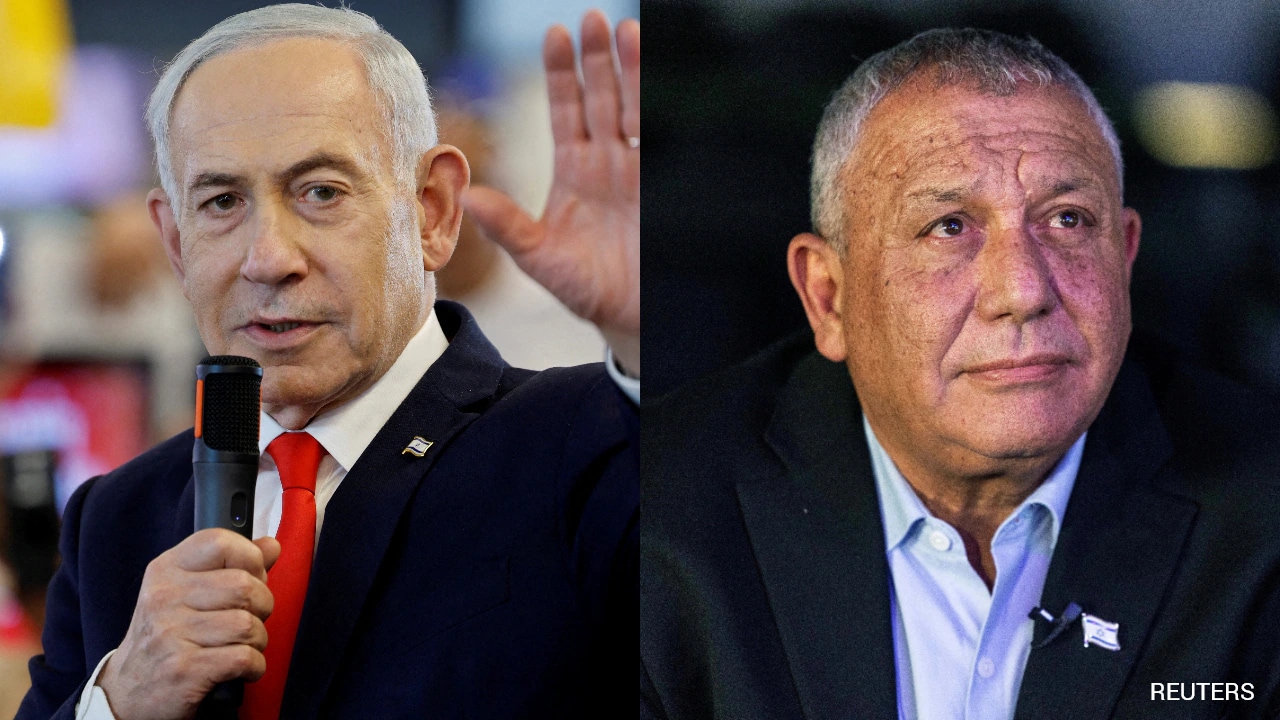
Israel Election Results Live: Netanyahu, Rival Eisenkot Both Claim Mandate After Tight Israel Election

JERUSALEM — In a high-stakes electoral showdown that has once again exposed deep societal fractures, incumbent Prime Minister Benjamin Netanyahu and centrist challenger Gadi Eisenkot both claimed victory early Wednesda…

A
Abinash
Verified Editorial Staff
Published: Wed, Oct 28, 2026
New Delhi Bureau • Movement News Digital
Share This Story
Israel Election Results Live: Netanyahu, Rival Eisenkot Both Claim Mandate After Tight Israel Election
Press Photographic Archive • Movement News Verified Visual Record

★ Key Story Takeaways & Findings

  • •Verified coverage reported by World & Geopolitics Desk.
  • •Fact-checked against primary sources and official dispatches.
  • •Updated and maintained in real-time by the Movement News Network.
Israel Election Results Live: Netanyahu, Rival Eisenkot Both Claim Mandate After Tight Israel Election
JERUSALEM — In a high-stakes electoral showdown that has once again exposed deep societal fractures, incumbent Prime Minister Benjamin Netanyahu and centrist challenger Gadi Eisenkot both claimed victory early Wednesday morning as preliminary tallies rolled in from a fiercely contested parliamentary election. With over 80 percent of the ballots processed by the Central Election Committee, neither camp secured an outright majority of 61 seats in the 120-member Knesset, plunging the nation into an immediate period of intense political uncertainty. The final tally is due within the next 48 hours, though an official certified result remains unlikely before Thursday evening.

The razor-thin margins reflect a deeply polarized electorate grappling with profound security concerns, economic pressures, and ongoing geopolitical instability across the Middle East. Both major political blocs spent election night rallying their base constituents, declaring operational momentum, and signaling their intention to initiate coalition-building negotiations immediately. The institutional machinery of the state, overseen by electoral officials operating under strict transparency guidelines, is currently auditing thousands of contested ballots from remote districts and military installations.

For ordinary citizens, the immediate impact is a continuation of political paralysis that has characterized Israeli governance over successive cycles. Financial markets responded with muted caution, while civil society groups called for calm and respect for democratic norms as the protracted government-formation process begins. Forming a stable governing coalition could take days or even weeks of arduous behind-the-scenes bargaining, leaving crucial budgetary and defense decisions in a state of legislative limbo.

📌 Essential Story Takeaways

  • Both Benjamin Netanyahu and Gadi Eisenkot claimed a mandate following preliminary tallies in a tightly contested parliamentary election.
  • Neither major political bloc secured the requisite 61-seat majority in the 120-member Knesset, necessitating complex coalition negotiations.
  • The Central Election Committee confirmed that final tallies are expected within 48 hours, with certified results projected by Thursday.
  • Economic stakeholders and foreign allies are monitoring the government-formation process closely amid regional security and fiscal pressures.

Historical Background & Contextual Precedents

Israel’s current electoral deadlock is the direct product of a fragmented multi-party political system that has struggled to produce durable governance over the past decade. Rooted in proportional representation with a low electoral threshold, the Knesset regularly accommodates numerous factional parties representing distinct ideological, religious, and ethnic constituencies. This structural design, while ensuring broad democratic inclusion, has historically empowered fringe factions to wield disproportionate leverage during coalition formations.

The rivalry between Netanyahu’s right-wing bloc and the centrist alternative led by figures like Eisenkot represents a fundamental ideological struggle over the future character of the state, judicial oversight, and regional diplomacy. Precedents from recent cycles—which saw multiple elections within a short span—demonstrate that coalition talks are fraught with brinkmanship, ideological compromises, and intense personal rivalries. Today’s standoff surfaced because neither traditional alliances nor newly formed political alignments could bridge the deep societal divides on core governance issues.

Deep-Dive Investigation & Sectoral Impact

A deep-dive analysis of voting patterns reveals stark geographic and demographic polarization across the country. Urban centers, particularly the greater Tel Aviv metropolitan area, leaned heavily toward the centrist and secular platforms, citing concerns over democratic institutions, cost of living, and international relations. Conversely, peripheral towns and traditional conservative strongholds delivered robust majorities for the incumbent prime minister and his religious-nationalist allies, prioritizing national security, territorial sovereignty, and religious traditions.

Data from the Central Election Committee indicates voter turnout reached approximately 71.5 percent, a notable increase from previous cycles that underscores the high stakes perceived by the electorate. Behind the scenes, power dynamics are shifting rapidly as smaller, kingmaker parties—particularly ultra-Orthodox factions and single-issue slate representatives—position themselves to extract maximum policy and budgetary concessions. Supply chains and financial markets remain resilient for now, but institutional analysts warn that prolonged political gridlock could delay crucial infrastructure investments and the upcoming fiscal budget.

Furthermore, electoral security measures were heightened following intelligence assessments regarding potential foreign interference and cyber threats targeting voting tabulation infrastructure. Cybersecurity teams reported successfully neutralizing several low-level probing attempts against administrative portals, ensuring the integrity of the vote count. Nevertheless, the reliance on manual verification in specific rural districts has slowed the overall reporting speed, contributing to the prolonged suspense.

Stakeholder Perspectives & Official Statements

Speaking at his campaign headquarters in Tel Aviv, Prime Minister Benjamin Netanyahu urged supporters to remain steadfast, asserting that his national camp represents the only stable path forward. ‘The people have spoken, and they want strong, experienced leadership to navigate these turbulent times,’ Netanyahu stated, adding that he has already initiated contacts with potential coalition partners.

In stark contrast, challenger Gadi Eisenkot addressed his followers in Jerusalem, framing the results as a mandate for systemic change and governmental renewal. ‘The era of division must end; our nation demands a unified government dedicated to public service, economic equity, and democratic integrity,’ Eisenkot declared. Independent political analysts suggest that the high voter turnout indicates a desperate public desire for decisive governance, regardless of ideological affiliation.

International observers, including diplomats from Western allies and regional partners, have issued measured statements emphasizing the importance of democratic resilience. Financial analysts warn that prolonged uncertainty could negatively impact foreign direct investment and credit ratings, making a swift, stable coalition formation an economic imperative.

Strategic Implications & Future Roadmap

Looking ahead, the immediate priority shifts to the official certification of election results by the Central Election Committee, anticipated by Thursday. Once certified, President Isaac Herzog will begin formal consultations with leaders of all elected parties to assess who holds the best prospect of assembling a viable governing coalition of at least 61 MKs.

Policy impact in the near term will likely focus on emergency appropriations, security expenditures, and navigating diplomatic engagements with regional and international stakeholders. Economic projections remain cautiously optimistic, provided a government is formed within the statutory 28-day window, with a possible 14-day extension granted by the president. Critical dates to watch include the swearing-in ceremony of the new Knesset and the subsequent presentation of the cabinet platform, which will set the legislative agenda for the foreseeable future.

❓ Key Questions Answered (FAQ)

Q: What is the primary trigger behind this development?

The primary trigger is a tightly contested parliamentary election resulting in neither major political bloc securing an outright majority in the 120-member Knesset, leading both incumbent Prime Minister Netanyahu and challenger Eisenkot to claim mandates.

Q: Who is most affected and what are the immediate consequences?

The Israeli public and financial markets are most affected, facing a period of political uncertainty and potential delays in budgetary decisions while coalition negotiations take place.

Q: What are the key upcoming dates and milestones to watch?

Key milestones include the final vote tally release within 48 hours, official certification by Thursday, and subsequent consultations led by President Isaac Herzog to initiate government formation.

Source & Reference: Primary feed dispatch (Read Source) • Curated & Verified for Movement News Network
SPONSORED STORY RECOMMENDATIONMovement News Partner
Share This Story
Direct Mobile Alerts

Never Miss Breaking News on Your Phone

Join The Movement News on WhatsApp and Telegram. Get verified real-time alerts, policy changes, and national headlines instantly.

★ More from World & Geopolitics

View Category Hub →

