
Sunday, October 18, 2026•🌤️Verified Digital Daily
BREAKING
[World & Geopolitics]Strict Time Caps on Firecracker Bursting Imposed by Minister Amid Rising Air Quality Concerns•[World & Geopolitics]BJP Leader’s Singer Wife, A Kabir Bhajan Gone Viral, And The ‘Jantar Mantar’ That Wasn’t•[Business & Economy]Sun Pharma Q2 Results: Profit Falls 36% YoY to Rs 1,989 Crore on Exceptional Charges•[Business & Economy]India made ‘remarkable progress’ in reducing poverty: World Bank•[Science & Technology]AU Small Finance Bank Investigates Potential Leak; Vijay Sales Systems Allegedly Offered for Sale•[Science & Technology]India Orders Sun Pharma to Halt Eye-Care Drug Production at Plant After Quality Lapses•[Sports & Games]Rohit Sharma Explains Why He Never Got To Wear His First Choice Jersey Number•[Sports & Games]ACT: India extends winning run, seals spot in the semifinals as Malaysia advances alongside•[National Affairs]Delhi Air Quality Drops To 78 After Record Rain Brings Winter Chill•[National Affairs]Supreme Court asks Centre to take measures against online misuse of court feeds•[World & Geopolitics]Strict Time Caps on Firecracker Bursting Imposed by Minister Amid Rising Air Quality Concerns•[World & Geopolitics]BJP Leader’s Singer Wife, A Kabir Bhajan Gone Viral, And The ‘Jantar Mantar’ That Wasn’t•[Business & Economy]Sun Pharma Q2 Results: Profit Falls 36% YoY to Rs 1,989 Crore on Exceptional Charges•[Business & Economy]India made ‘remarkable progress’ in reducing poverty: World Bank•[Science & Technology]AU Small Finance Bank Investigates Potential Leak; Vijay Sales Systems Allegedly Offered for Sale•[Science & Technology]India Orders Sun Pharma to Halt Eye-Care Drug Production at Plant After Quality Lapses•[Sports & Games]Rohit Sharma Explains Why He Never Got To Wear His First Choice Jersey Number•[Sports & Games]ACT: India extends winning run, seals spot in the semifinals as Malaysia advances alongside•[National Affairs]Delhi Air Quality Drops To 78 After Record Rain Brings Winter Chill•[National Affairs]Supreme Court asks Centre to take measures against online misuse of court feeds•
INDIA6 min read•✓ Verified Fact-Checked Report

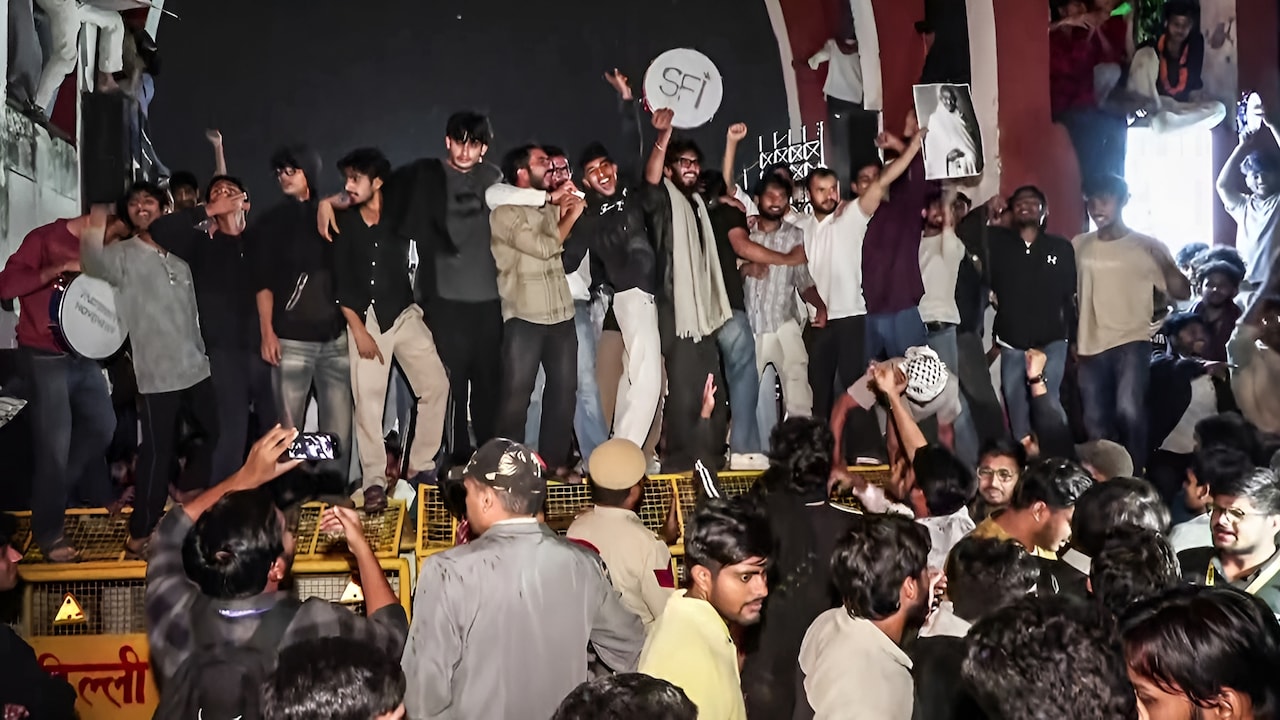
Jamia Finally Sets Dates For Restoring Students’ Union, Protest Ends With ‘Victory’ Celebrations

After weeks of intense demonstrations, administrative standoffs, and mounting pressure from the student fraternity, Jamia Millia Islamia has officially announced a definitive timeline for the restoration of its long-dorm…

A
Abinash
Verified Editorial Staff
Published: Thu, Oct 29, 2026
New Delhi Bureau • Movement News Digital
Share This Story
Jamia Finally Sets Dates For Restoring Students’ Union, Protest Ends With ‘Victory’ Celebrations
Press Photographic Archive • Movement News Verified Visual Record

★ Key Story Takeaways & Findings

  • •Verified coverage reported by National Affairs Desk.
  • •Fact-checked against primary sources and official dispatches.
  • •Updated and maintained in real-time by the Movement News Network.
Jamia Finally Sets Dates For Restoring Students' Union, Protest Ends With 'Victory' Celebrations
After weeks of intense demonstrations, administrative standoffs, and mounting pressure from the student fraternity, Jamia Millia Islamia has officially announced a definitive timeline for the restoration of its long-dormant students’ union and subsequent democratic elections. The breakthrough arrived late Tuesday evening following marathon negotiations between university authorities and student representatives, effectively halting an agitation that had threatened to paralyze campus operations.

The announcement marks a monumental turning point for one of India’s premier central universities, where student politics has remained heavily suppressed or entirely absent for several years. The administration’s sudden concession—reversing its earlier stance where no concrete dates were offered during initial settlement attempts—has transformed the campus atmosphere from one of palpable tension into fervent jubilation.

For the thousands of students who maintained round-the-clock sit-ins outside the administrative block, the calendar of events represents not just the return of institutional democracy, but the culmination of a grueling endurance test. As victory chants echoed through the historic red-brick corridors, stakeholders across the academic spectrum began assessing the broader ramifications of this hard-fought administrative capitulation for student representation nationwide.

📌 Essential Story Takeaways

  • Jamia Millia Islamia administration has formally issued a detailed schedule for restoring the students' union and conducting democratic elections.
  • The breakthrough follows weeks of escalating protests, hunger strikes, and administrative deadlocks that paralyzed core campus functions.
  • Student bodies successfully compelled the university to abandon its earlier ambiguous stance, establishing a binding precedent for institutional accountability.
  • The upcoming election roadmap includes voter registration drives, constitutional amendments, and the official lifting of the campus political ban.

Historical Background & Contextual Precedents

The suppression of student union elections at Jamia Millia Islamia is part of a broader, decade-long national trend across several central and state universities in India, where administrations have increasingly clamped down on organized student politics citing disciplinary concerns and academic continuity. For years, Jamia students operated in a democratic vacuum, denied a formal, legally recognized platform to voice grievances regarding hostel fees, academic infrastructure, library timings, and broader socio-political issues. Previous attempts to revive the union were systematically stonewalled by successive administrative regimes, which often utilized punitive measures, show-cause notices, and police interventions to deter mobilization.

The current crisis, however, proved fundamentally different due to the unprecedented unity displayed across disparate student factions and ideological groups. When the administration attempted to broker a weak settlement last month without committing to specific electoral dates, it miscalculated the resolve of the student body. The refusal to accept vague promises galvanized a grassroots movement that bypassed traditional bureaucratic channels, utilizing digital mobilization and sustained physical occupation of public spaces to force the university’s hand, ultimately culminating in this historic concession.

Deep-Dive Investigation & Sectoral Impact

A deep-dive investigation into the dynamics of the Jamia protest reveals a meticulously coordinated campaign orchestrated by a newly emergent coalition of independent student activists, gender equality collectives, and legacy student wings. Unlike previous agitations that fractured along predictable ideological lines, this movement maintained strict discipline, refusing to allow external political entities to hijack the discourse. Investigative interviews with student leaders highlight how digital transparency platforms and crowdsourced legal aid protected protesters from arbitrary disciplinary actions, shifting the balance of power away from the authoritarian tendencies of the proctorial board.

Concurrently, internal university memos leaked during the standoff exposed deep divisions within the executive council itself. While conservative elements within the administration advocated for a hardline approach involving mass suspensions and campus closures, moderate academic leaders warned that continued suppression would trigger catastrophic reputational damage and potential judicial intervention from the Delhi High Court, where several petitions regarding campus democracy were already pending. This internal schism, combined with the sheer economic and logistical disruption of a paralyzed campus, ultimately compelled the vice-chancellor’s office to prioritize institutional compromise over continued conflict, laying the groundwork for the eventual capitulation.

Stakeholder Perspectives & Official Statements

Reactions to the breakthrough have been swift and multifaceted, reflecting the high-stakes nature of university politics in the capital. A prominent student leader, speaking on condition of anonymity due to ongoing administrative protocols, declared the development ‘a monumental vindication of constitutional rights over arbitrary administrative fiat.’ The representative emphasized that the union would prioritize academic welfare, gender safety audits, and fee rationalization once formally established.

Conversely, university officials have struck a more measured, cautionary tone in their public statements. A senior administrator, representing the registrar’s office, insisted that the restoration of the union must operate within strict institutional guidelines to ensure that academic rigor is not compromised by partisan politicking. Legal experts and civil liberties advocates have also weighed in, praising the students for their tenacity while cautioning that the administration’s historical reluctance necessitates vigilant oversight throughout the upcoming election cycle to prevent backdoor disqualifications or suppression of dissenting voices.

Strategic Implications & Future Roadmap

With the dates now officially set, Jamia Millia Islamia enters a critical transition phase that will test the willingness of both students and authorities to engage in constructive democratic engagement. The immediate horizon features a tightly compressed schedule: the release of the draft election constitution, the establishment of an independent election commission comprising senior faculty members, and the initiation of voter rolls.

Economically and administratively, the return of an elected union is expected to streamline grievance redressal mechanisms, potentially averting costly litigation and protracted campus unrest. However, the true test will emerge post-election, when the newly minted student leadership must navigate complex negotiations with the central ministry and university bureaucracy over policy reforms. Critical milestones to watch include the notification date for candidate nominations, the presidential debates scheduled for next month, and the final swearing-in ceremony, which will formally cement this chapter of student-led victory in modern Indian academic history.

❓ Key Questions Answered (FAQ)

Q: What is the primary trigger behind this development?

The primary trigger was weeks of relentless student protests, hunger strikes, and sit-ins demanding a binding timeline for the restoration of the university's banned students' union after initial administrative settlement attempts offered no concrete dates.

Q: Who is most affected and what are the immediate consequences?

The entire Jamia Millia Islamia academic community is affected, with thousands of students regaining formal democratic representation, while the administration faces a restructured framework for student engagement and policy dialogue.

Q: What are the key upcoming dates and milestones to watch?

Key milestones include the release of the draft election constitution, the opening of voter registration, candidate nomination windows, and the final polling date scheduled for the upcoming academic cycle.

Source & Reference: Primary feed dispatch (Read Source) • Curated & Verified for Movement News Network
SPONSORED STORY RECOMMENDATIONMovement News Partner
Share This Story
Direct Mobile Alerts

Never Miss Breaking News on Your Phone

Join The Movement News on WhatsApp and Telegram. Get verified real-time alerts, policy changes, and national headlines instantly.

★ More from National Affairs

View Category Hub →
ADVERTISEMENTMovement News Partner
