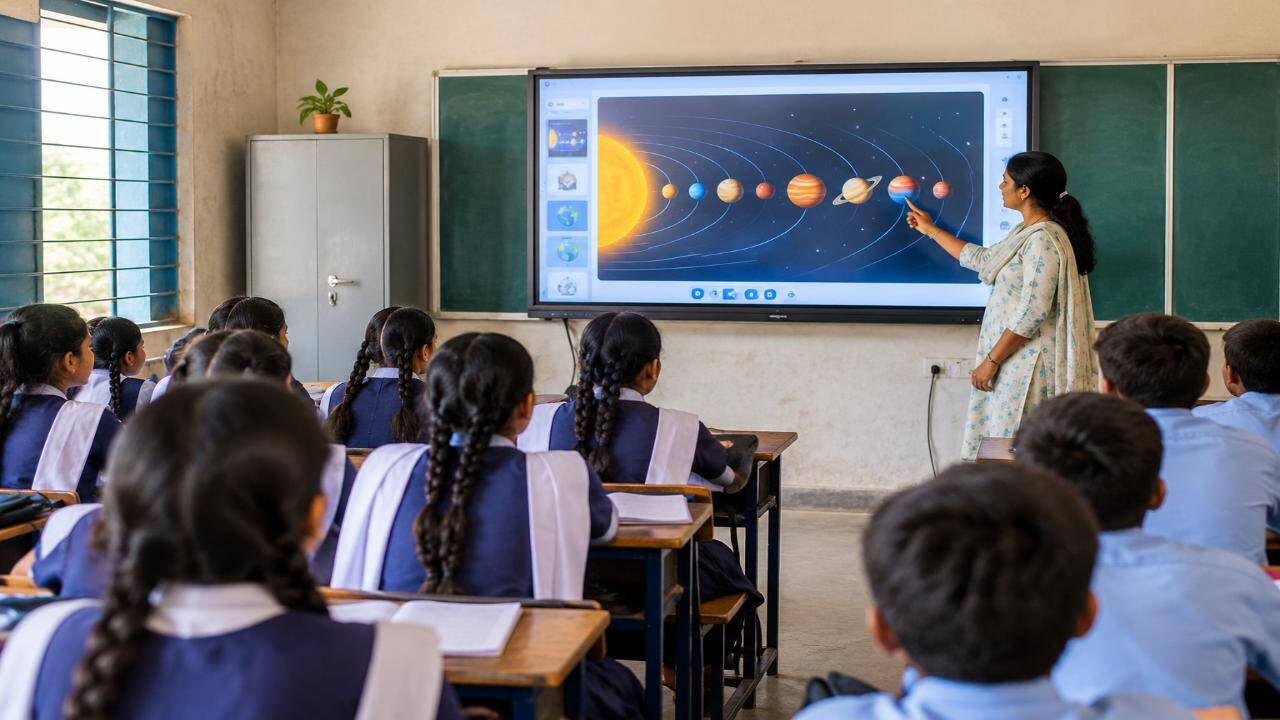
Spearheaded by regional education administrators in collaboration with grassroots technology non-profits, the project directly targets the systemic infrastructure deficits plaguing rural India. By circumventing the need for high-speed fiber-optic cables or erratic mobile networks, the initiative ensures uninterrupted delivery of animated science modules, mathematical simulations, and multilingual literacy programs. The immediate societal impact is profound, injecting a renewed sense of enthusiasm into a student body that was previously at risk of falling far behind their urban counterparts in foundational competencies.
Beyond immediate classroom engagement, the program serves as a scalable blueprint for educational equity across India’s thousands of digitally isolated hamlets. As policymakers evaluate the initial rollout, educators note a sharp decline in absenteeism and a measurable improvement in cognitive retention rates among primary and secondary cohorts. This dispatch examines the mechanics of offline digital deployment, the socio-economic hurdles overcome by local educators, and the broader implications for India’s national education policy framework.
📌 Essential Story Takeaways
- Over 660 students in Sarai Tand, Bihar, now access advanced digital curricula without relying on internet connectivity.
- The model utilizes pre-loaded offline servers and local caching to bypass chronic rural broadband failures.
- Educator training programs have been instituted to ensure seamless integration of animated content into daily lesson plans.
- The initiative acts as a scalable framework for India's Ministry of Education to bridge rural-urban learning divides.
Historical Background & Contextual Precedents
This chronic failure created an escalating learning deficit, widening the chasm between urban students—who enjoy seamless access to global knowledge repositories—and rural youth confined to outdated textbooks and demoralized chalk-and-board methods. The crisis deepened sharply during the post-pandemic era, when online education models became the urban norm while rural areas experienced catastrophic learning losses. Recognizing that waiting for ubiquitous high-speed internet was a pipe dream, pioneering technologists and local educators shifted paradigms: instead of bringing the cloud to the village, they brought the server to the classroom.
Today’s success in Sarai Tand surfaced from months of meticulous pilot testing, leveraging open-source educational repositories compressed to fit onto localized, low-power micro-servers. By designing systems that operate entirely on local area networks (LAN) powered by solar-backed inverters, the project successfully insulated itself against the dual plagues of Bihar’s rural landscape: power outages and bandwidth starvation. This historical pivot marks a fundamental shift from dependency-based development to self-sustaining technological adaptation in India’s public education sector.
Deep-Dive Investigation & Sectoral Impact
Supply chain logistics for this project required navigating significant bureaucratic hurdles and rough rural terrains. Procuring durable hardware capable of withstanding high ambient temperatures, voltage fluctuations, and dust required partnering with specialized social enterprises rather than standard commercial vendors. Furthermore, the financial sustainability of the project hinges on community stewardship; local school management committees have established decentralized maintenance funds to protect and service the equipment.
Power reliability, traditionally the Achilles’ heel of rural technological interventions, was solved through an integrated solar-hybrid power grid. When the main grid fails—a frequent occurrence during peak summer months—the classroom’s dedicated solar array seamlessly takes over, ensuring zero instructional downtime. Yet, power and hardware are only half the equation. Our investigation found that the true catalyst of the program’s success is an intensive, continuous teacher-training regimen. Initially apprehensive educators, many of whom possessed minimal digital literacy themselves, have evolved into confident facilitators, seamlessly blending traditional pedagogical discipline with modern digital tools to maximize student engagement.
Stakeholder Perspectives & Official Statements
Local educators emphasize the psychological shift observed among the student body. Sunita Devi, a senior mathematics teacher at the school, shared her perspective during an interview: ‘When children see complex geometric theorems animated in 3D right before their eyes, their eyes light up in a way a flat textbook drawing could never achieve. They are no longer just memorizing formulas; they are visualizing concepts.’ Parents, too, have expressed overwhelming support, viewing the initiative as a rare equalizer that grants their children access to competitive educational standards once reserved for elite private institutions.
However, critics and fiscal analysts sound a note of caution regarding long-term scalability and maintenance. While the initial deployment has been funded through philanthropic grants and corporate social responsibility (CSR) initiatives, economists question how the Bihar state government plans to replicate and maintain thousands of such units sustainably without relying indefinitely on external donors. Educational bureaucrats maintain that successful pilot data will be used to lobby for dedicated line-item allocations in the upcoming state fiscal budget, ensuring institutional longevity.
Strategic Implications & Future Roadmap
Critical milestones to watch include the release of the comprehensive year-end learning assessment data in late Q4, which will quantitatively measure improvements in standardized test scores among the participating 660 students against a control group of traditional classrooms. Additionally, upcoming supply chain partnerships with indigenous hardware manufacturers aim to reduce unit costs by 30%, making mass replication financially viable for cash-strapped state administrations. If sustained, Sarai Tand may well redefine the blueprint for educational delivery across the Global South, proving that physical isolation need no longer be a permanent barrier to intellectual empowerment.
❓ Key Questions Answered (FAQ)
The primary trigger is the acute, chronic failure of rural broadband infrastructure and erratic power supply in Sarai Tand, Bihar, which left 660 government school students isolated from national digital education drives and widened rural-urban learning gaps.
The 660 students and local educators of the Sarai Tand government school are directly affected. Immediate consequences include a sharp decline in student absenteeism, heightened engagement through interactive multimedia, and a significant boost in foundational literacy and numeracy comprehension.
Key milestones include the release of comprehensive year-end learning assessment data in late Q4 to measure quantitative educational gains, and the upcoming Bihar state legislative session where officials will review the pilot for potential statewide scaling.